

SWRO Systems for Offshore Oil Platforms and Supply Vessels
Offshore oil platforms, FPSO units, and marine supply vessels operate in environments where reliable freshwater supply is essential but often difficult to maintain. Unlike coastal facilities, offshore installations cannot easily connect to municipal water networks. Transporting freshwater by ship is possible, but it increases logistics requirements, storage needs, and operating costs.
seawater reverse osmosis (SWRO) systems provide a practical solution by converting surrounding seawater into freshwater directly at the offshore location. With appropriate seawater intake, pretreatment, high-pressure pumping, membrane separation, and post-treatment, offshore facilities can produce freshwater for crew accommodation, equipment cleaning, drilling support, and other operational requirements.
However, offshore desalination systems face challenges that are different from land-based plants. Limited installation space, vibration, salt spray, changing seawater conditions, limited maintenance access, and strict safety requirements all influence system design.
A successful offshore SWRO system must therefore combine reliable water production with compact structure, corrosion resistance, automation, and simplified maintenance.
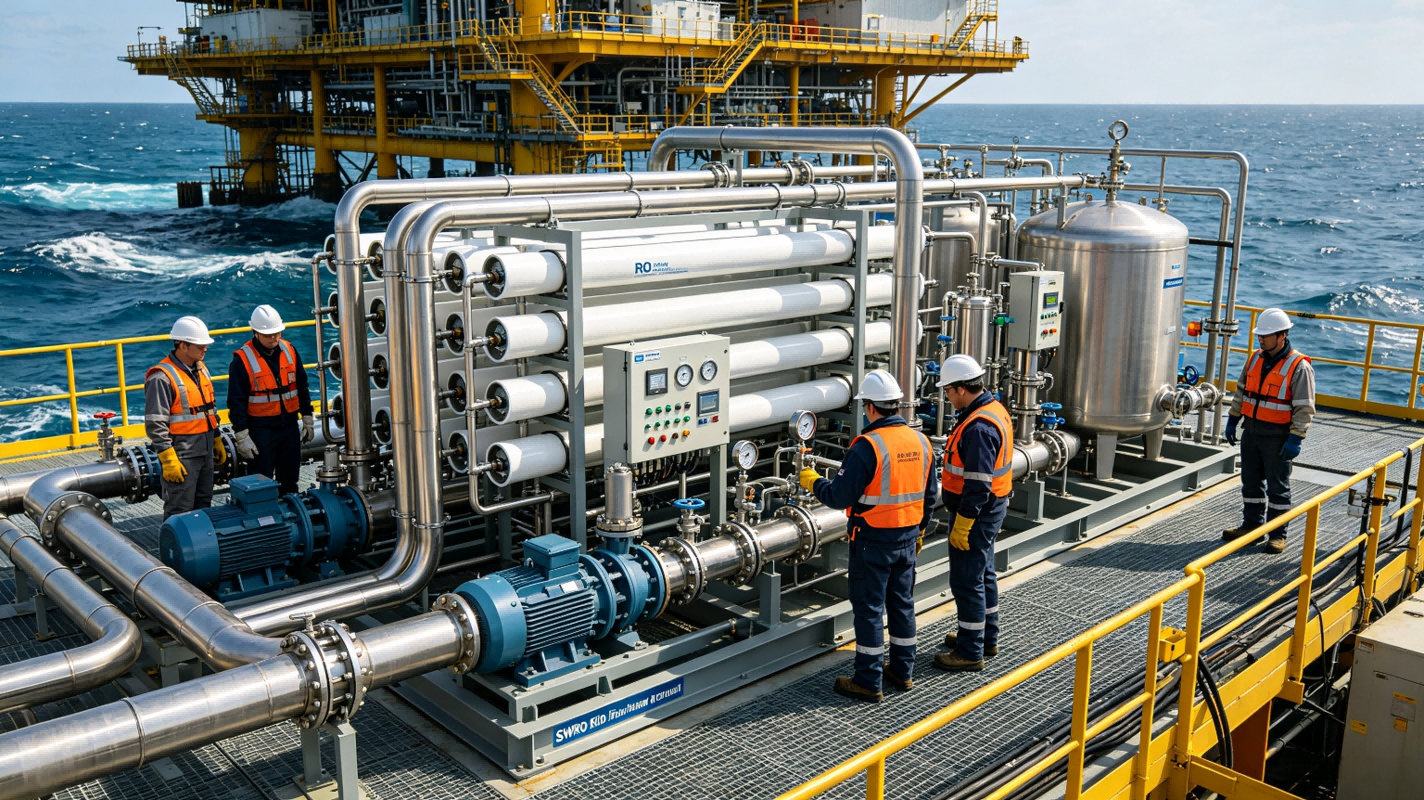
Freshwater is a critical resource for offshore operations.
Oil platforms and marine facilities require freshwater for many purposes, including:
Drinking water production
Crew accommodation
Cooking and sanitation
Equipment cleaning
Maintenance activities
Industrial processes
Emergency water supply
The number of people onboard may vary depending on the facility type and operating phase. A large offshore platform may support many workers, while a smaller supply vessel may require a compact freshwater system with lower production capacity.
Without a reliable freshwater source, offshore operations must depend on transported water supplies. This creates additional challenges:
Increased transportation frequency
Larger freshwater storage requirements
Higher logistics costs
Dependence on weather conditions
Additional loading and handling operations
By producing freshwater from seawater, SWRO systems reduce dependence on external water delivery and improve operational flexibility.
SWRO desalination technology can be used in different marine applications.
Fixed platforms and offshore production facilities often require continuous freshwater production for personnel and operational needs.
The desalination system is usually installed in a dedicated equipment area or integrated into the platform utility system.
Important design considerations include:
Available deck space
Platform load limitations
Power supply
Seawater quality
Safety requirements
Maintenance accessibility
Floating Production Storage and Offloading (FPSO) vessels combine offshore production and storage functions.
Because FPSOs operate independently at sea for extended periods, freshwater production capability is an important part of onboard utilities.
An SWRO system on an FPSO must be designed to withstand:
Vessel movement
Vibration
Limited space
Marine corrosion
Continuous operation requirements
Supply vessels support offshore platforms by transporting equipment, materials, and personnel.
Many modern vessels use onboard desalination systems to produce freshwater for:
Crew facilities
Vessel operations
Cleaning
Maintenance
Compact SWRO units are often suitable because available installation space is limited.
The basic operating principle of an offshore SWRO system is similar to land-based Seawater Desalination Plants.
The process generally includes:
Seawater Intake → Pretreatment → High-Pressure Pump → RO Membrane System → Post-Treatment → Freshwater Storage
The first step is collecting seawater from the surrounding marine environment.
The intake system must consider:
Suspended solids
Marine organisms
Temperature changes
Seasonal seawater variation
Vessel movement
Platform structure
For offshore installations, the intake arrangement may include seawater pumps, strainers, filtration systems, and monitoring instruments.
A stable seawater supply helps protect downstream pretreatment and membrane performance.
Pretreatment is particularly important in marine environments.
Seawater may contain:
Sand particles
Sediment
Organic matter
Algae
Microorganisms
Suspended solids
If these contaminants reach the RO membranes, they can contribute to fouling and reduced system performance.
Common pretreatment components include:
Automatic screen filters
Multimedia filters
Cartridge filters
Ultrafiltration systems
Chemical dosing systems
The selected configuration depends on seawater quality and operating requirements.
For offshore applications, pretreatment equipment should also be designed for simple operation because maintenance opportunities may be limited.
The high-pressure pump is one of the most important components in an SWRO system.
Reverse osmosis requires pressure higher than the natural osmotic pressure of seawater. The pump provides the driving force that pushes water through the RO membrane.
Offshore high-pressure pumping systems must consider:
Available electrical power
Energy efficiency
Equipment footprint
Vibration control
Noise requirements
Maintenance access
Energy recovery devices can improve efficiency in larger systems by recovering energy from the high-pressure concentrate stream.
For smaller offshore units, system simplicity may sometimes be more important than maximum energy optimization.
The final design depends on production capacity and operational requirements.
The RO membrane system is the core separation unit.
Inside the pressure vessels, seawater flows across spiral-wound membrane elements. Water molecules pass through the membrane, while most dissolved salts are rejected.
The system produces:
Permeate: freshwater product
Concentrate: higher-salinity brine stream
Offshore membrane system design should consider:
Required freshwater capacity
Feed salinity
Recovery rate
Operating pressure
Membrane fouling potential
Because replacing membrane elements offshore can be more difficult than on land, maintaining stable pretreatment and operating conditions is especially important.
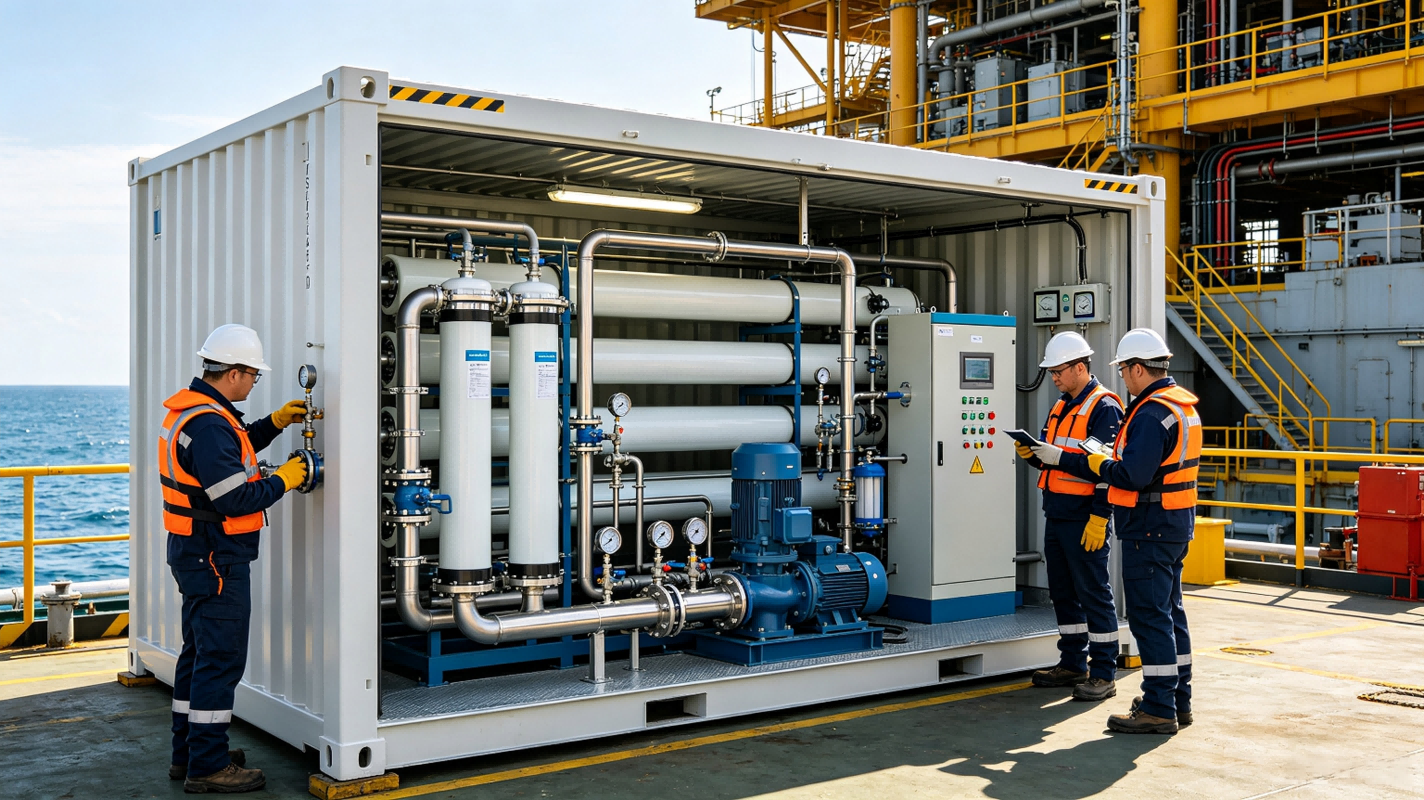
Space is one of the biggest limitations offshore.
Unlike large coastal desalination plants, offshore installations often have strict restrictions on:
Equipment footprint
Weight
Structural loading
Access space
Installation time
For this reason, compact and modular SWRO systems are widely considered for offshore applications.
A modular system may integrate:
Pretreatment equipment
High-pressure pump
RO pressure vessels
Control cabinet
Chemical dosing
Instrumentation
Piping connections
Skid-mounted designs can simplify transportation, installation, and replacement.
Containerized systems may also be used where suitable, especially for temporary offshore projects or remote marine facilities.
Offshore environments create demanding corrosion conditions.
Equipment is exposed to:
Salt spray
High humidity
Continuous seawater contact
Temperature changes
Chemical cleaning solutions
Material selection is therefore critical.
Common corrosion-resistant materials may include:
Stainless steel
Duplex stainless steel
Titanium
FRP
Engineering plastics
Different components may require different materials.
For example:
Seawater piping requires strong corrosion resistance
High-pressure components require both strength and corrosion resistance
Chemical dosing systems require chemical compatibility
Instrument connections require reliable sealing
Proper welding, fabrication quality, surface treatment, and installation practices are also important for long-term offshore reliability.
The desalination system is only one part of the offshore water supply system.
Freshwater storage tanks provide a buffer between production and consumption.
Storage capacity should consider:
Number of personnel onboard
Daily water demand
Emergency requirements
Desalination system availability
Maintenance periods
The distribution system should also be designed carefully.
Important components include:
Pumps
Pipes
Valves
Filters
Disinfection systems
Monitoring instruments
For drinking water applications, additional treatment may be required to meet the required water quality standards.
Offshore facilities often operate with limited personnel.
Automation helps improve reliability by continuously monitoring system conditions.
Typical monitored parameters include:
Feed pressure
RO pressure
Permeate flow
Conductivity
Differential pressure
Temperature
Tank level
Pump operation
Filter condition
A centralized control system can provide operators with real-time information about system performance.
Remote monitoring is also valuable because technical teams onshore can review operating data and support troubleshooting.
However, automation does not eliminate the need for routine inspection and preventive maintenance.
Maintenance planning is one of the most important aspects of offshore SWRO design.
Compared with land-based plants, offshore maintenance can be more difficult because:
Spare parts require transportation
Weather may affect access
Equipment space is limited
Repair opportunities are less frequent
Therefore, offshore systems should be designed for reliability and easy service.
Important considerations include:
Easy access to filters
Simple chemical dosing replacement
Modular component replacement
Clear instrument layout
Spare parts planning
Condition monitoring
Preventive maintenance is generally more practical than waiting for equipment failure.
RO membranes may experience fouling or scaling during operation.
Common causes include:
Suspended solids
Organic fouling
Biological growth
Mineral scaling
Performance indicators help determine when cleaning may be required.
Operators typically monitor:
Normalized permeate flow
Salt rejection
Feed pressure
Differential pressure
Conductivity
When membrane performance decreases significantly, a clean-in-place (CIP) procedure may be performed.
The cleaning method depends on the type of fouling and should follow appropriate chemical compatibility requirements.
SWRO systems produce a concentrate stream containing higher salinity than the incoming seawater.
For offshore applications, brine discharge is usually managed through carefully designed marine discharge arrangements.
The system should consider:
Discharge location
Flow rate
Mixing conditions
Environmental requirements
Platform or vessel design limitations
The objective is to manage concentrate safely while maintaining reliable desalination operation.
The discharge arrangement should be evaluated together with the overall offshore facility design.
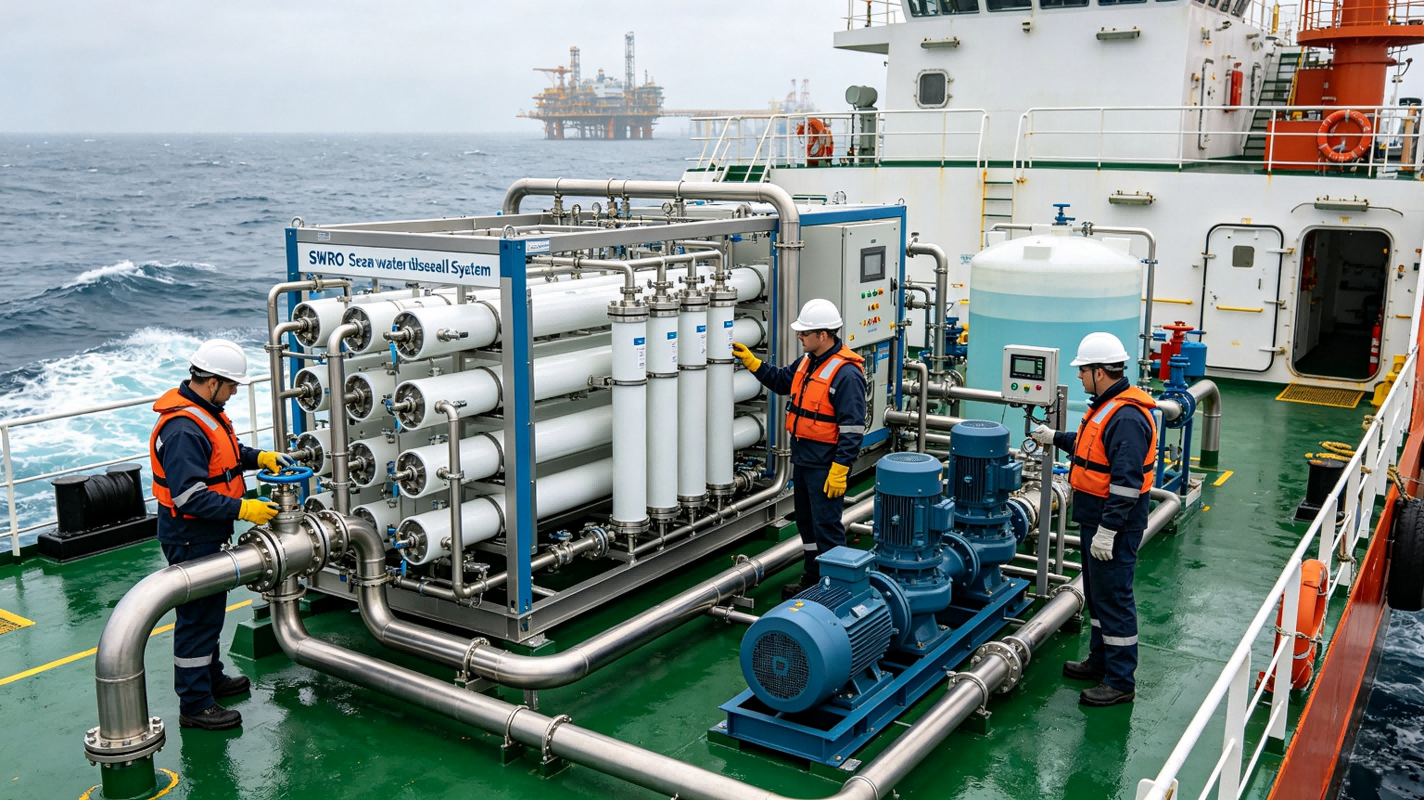
Marine supply vessels have unique requirements compared with fixed platforms.
The equipment must tolerate:
Ship movement
Vibration
Limited space
Variable operating conditions
Important design features may include:
Compact skid structure
Shock-resistant installation
Automatic operation
Easy access for maintenance
Corrosion-resistant materials
The freshwater demand of the vessel determines the required production capacity.
A smaller crew vessel may require a compact unit, while larger offshore support vessels may require higher-capacity systems.
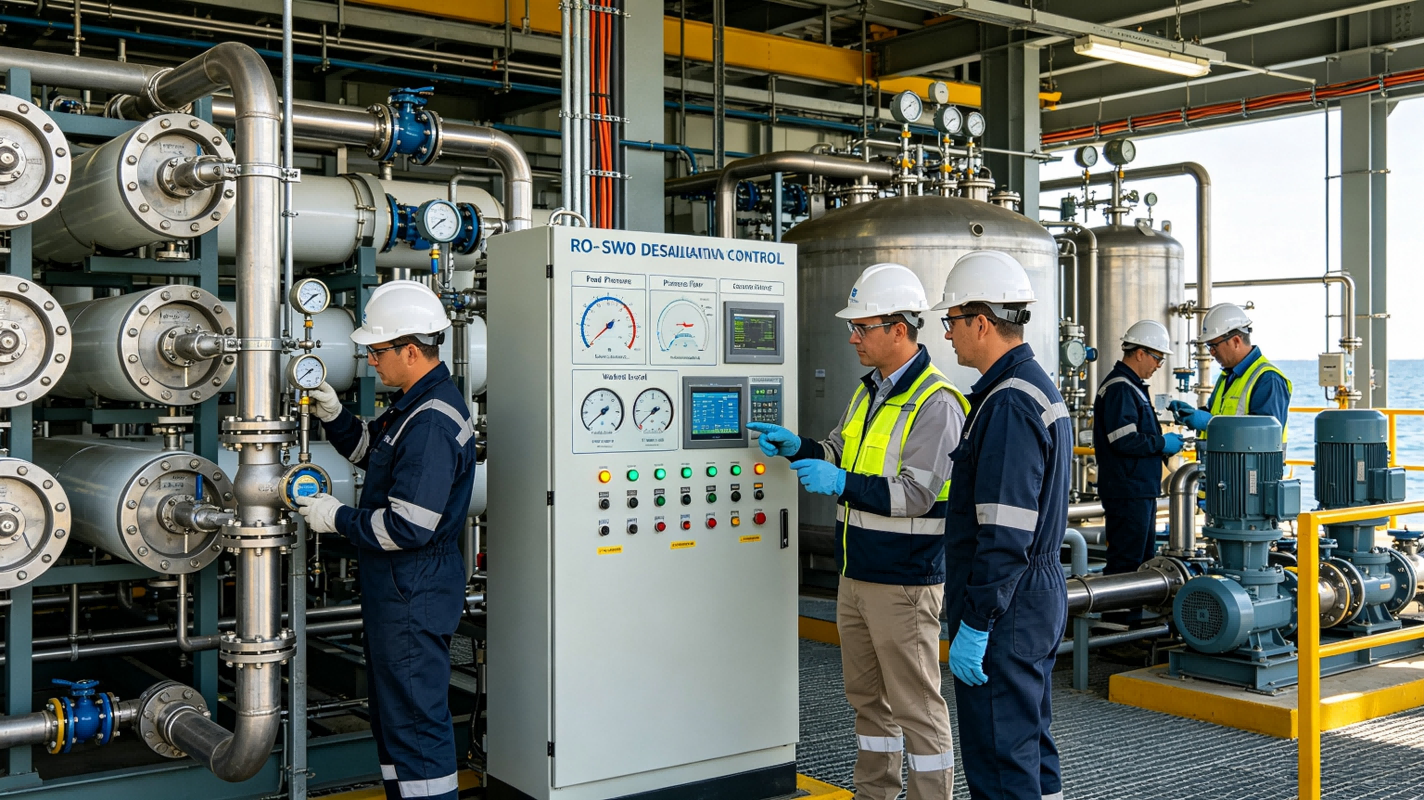
Energy availability influences offshore desalination design.
Possible power sources include:
Platform electrical systems
Ship generators
Hybrid energy systems
The desalination system should be matched with the available power supply.
Energy-efficient pumps, optimized operating pressure, and appropriate system recovery can help reduce overall power consumption.
For offshore facilities, reliability is often equally important as energy efficiency because equipment downtime can affect the entire operation.
Offshore environments have strict safety requirements.
Desalination equipment should consider:
Electrical safety
Pressure safety
Chemical handling
Fire protection requirements
Access and maintenance safety
Equipment layout should allow safe operation and inspection.
Chemical dosing systems, in particular, require appropriate storage, ventilation, and handling procedures.
Offshore desalination projects rarely use a one-size-fits-all solution.
The system configuration depends on:
Platform type
Vessel size
Crew capacity
Freshwater demand
Seawater quality
Available power
Installation space
Operating environment
Maintenance capability
A customized approach allows engineers to select appropriate membrane capacity, pretreatment, pump configuration, materials, automation level, and storage capacity.
For example, a small offshore supply vessel may prioritize compact installation, while a large production platform may require redundancy and continuous operation.
SWRO systems provide offshore oil platforms, FPSO units, and supply vessels with a reliable method of producing freshwater directly from seawater.
Unlike land-based desalination plants, offshore systems must operate under more demanding conditions, including limited space, marine corrosion, vibration, changing seawater conditions, and restricted maintenance access.
A successful offshore SWRO solution requires careful consideration of seawater intake, pretreatment, high-pressure pumping, membrane design, materials, automation, storage, and maintenance planning.
Compact skid-mounted systems, containerized units, corrosion-resistant components, and remote monitoring technologies make it possible to integrate desalination into offshore environments more effectively.
For offshore operators, the most suitable desalination system is not simply the one with the highest production capacity. It is the system that matches the platform or vessel requirements, available resources, operating conditions, and long-term maintenance strategy.
With proper engineering design, SWRO technology can provide a stable freshwater supply for offshore energy operations and marine facilities operating far from shore.
Situs web ini menggunakan cookie untuk memastikan Anda mendapatkan pengalaman terbaik di situs web kami.
 English
 Portugues
 Pусский
 Français
 العربية
 ไทย
ไทย Melayu
 Tiếng Việt
 中文
中文 қазақ
қазақ עִברִית
 မြန်မာ
 ພາສາລາວ
 Filipino
 o'zbek
 Кыргызча
 тоҷикӣ
 ខ្មែរ
ខ្មែរ Türkmenler



 Telepon
Komentar
(0)